
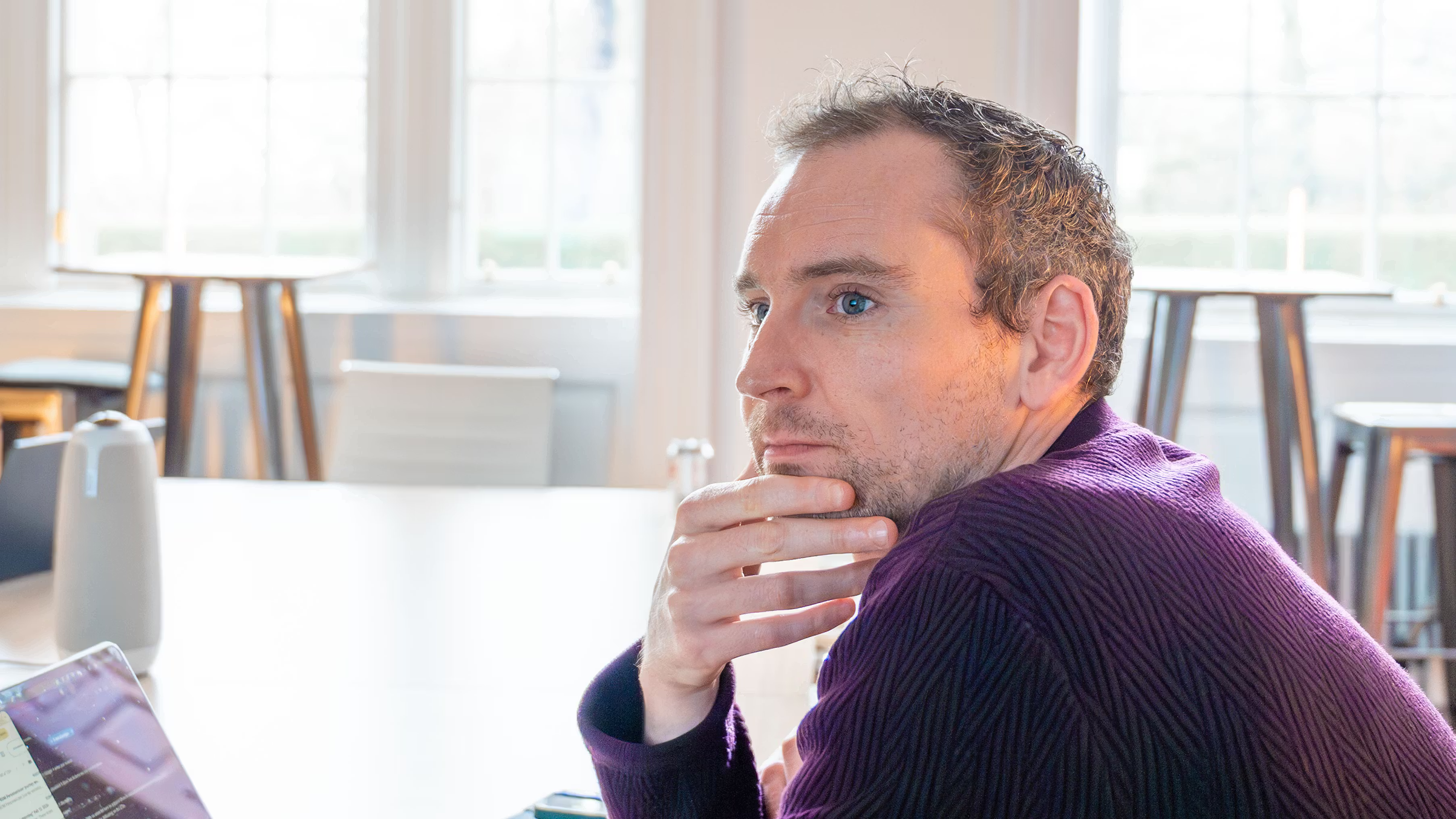
We are so proud of our teams and our people. ClearSky is made up of incredibly talented individuals across different disciplines. This week, we sat down with Emmet Rock from our design department to chat about his work, his ideas, and the impact of design. This was the conversation:
To start us off, tell us a little bit about yourself, your background, and the work you do at ClearSky?
I’m Emmet Rock, Senior Product Designer at ClearSky. My background spans finance, defense, robotics, and even space-tech startups. I am comfortable with high-complexity problems. I may not have the answer in the moment (how very human), but I do not stop researching, analysing, and deconstructing a problem space.
I’m a designer because I love difficult problems and ideating on the future. I aimed to be what I call a "futurist" when I was a child; while that’s been descoped somewhat, design remains the only function that affords the ability to be creative about problem-solving to meet both business and user requirements.
At ClearSky, I sit across client-facing product teams and the Future Labs team. My role is very much not interface design. A lot of my recent work has focused on AI enablement, not the ubiquitous chatbot trends, but deterministic AIs that recognise context. I’m interested in how architecture, data models, and design systems create leverage, so I spend my time working upstream.
What I care about most is positive impact. At ClearSky, the focus has been on building foundations. Helping clients move from feature-thinking to platform-thinking. We design systems that compound over time rather than fragment.
You work a lot on the discovery process with clients. Can you share a bit about how design works within the discovery process and how you collaborate with the team?
Design plays a critical role in discovery; it acts as the connective tissue between business ambition, user reality, and technical feasibility. At the start of a project, it’s not about screens, the focus is on framing the problem correctly.
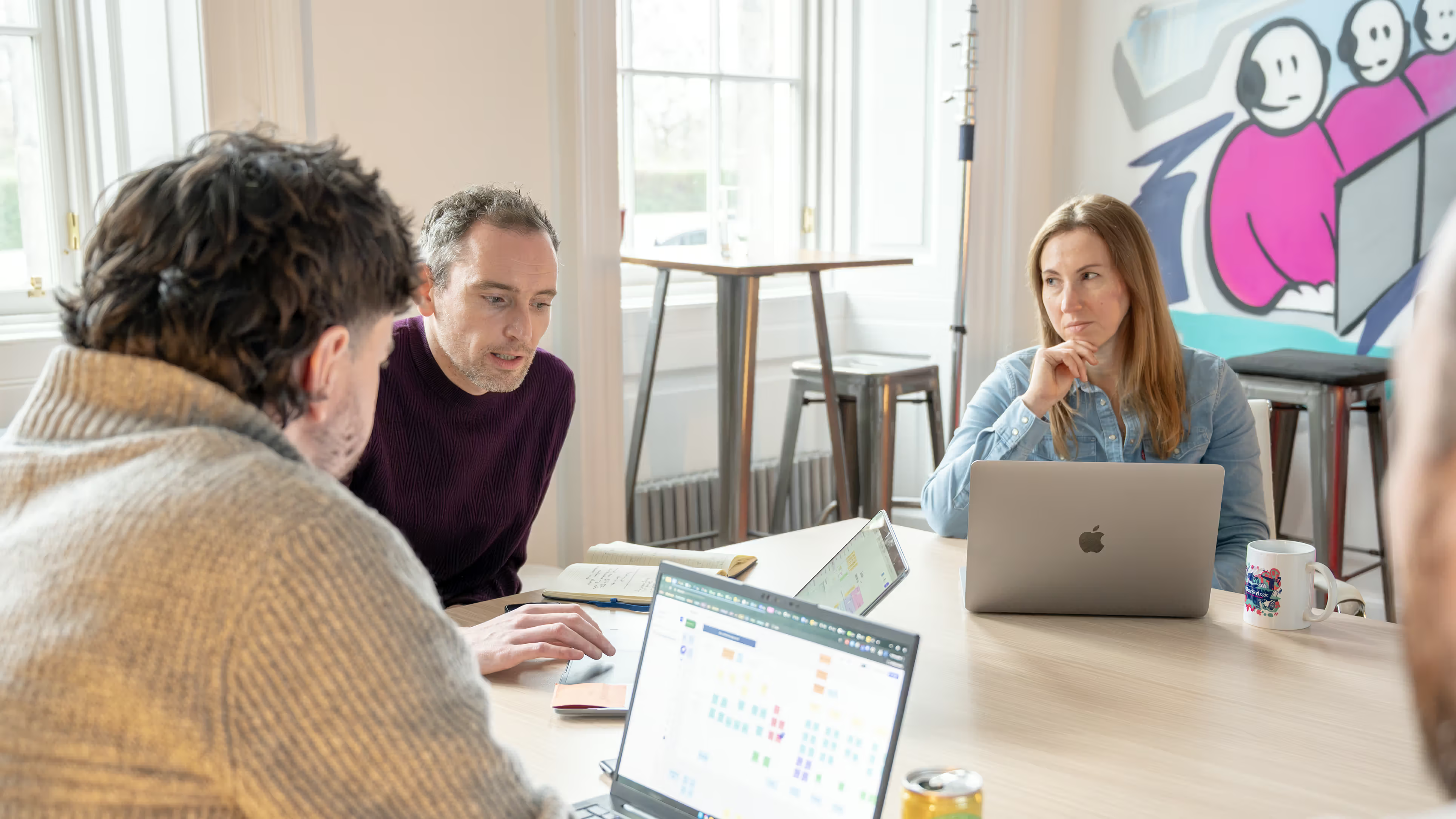
Discovery is about reducing ambiguity, and design helps do that by making abstract concepts tangible. We typically run workshops that surface assumptions, map stakeholders, and define what success actually means, not just in feature terms, but in behavioural and operational outcomes. From there, we move into mapping the ecosystem. That might involve:
- Journey mapping
- Service blueprints
- Value stream diagrams
These aren't just deliverables for their own sake; they are alignment tools and conversation instigators. They contribute to a shared understanding between product, engineering, and commercial teams about where friction exists and which constraints matter.
Collaboration with tech teams starts early. We prefer engineers in the room during discovery, not downstream. When we’re defining opportunity areas, we’re actively exploring technical realities with them, data structures, integration constraints, architectural debt, and security considerations. This prevents us from making design concepts that look compelling but are structurally brittle.
As we move from problem-framing to solution-shaping, I’ll often prototype quickly (lo-fi first) to test flows and surface edge cases. Engineers sanity-check feasibility while I assess usability and behavioural clarity. It’s less of a "hand-over" and more about co-authoring the shape of a system.
How would you describe the impact design & discovery has?
Design is impactful because it is one of the few disciplines that simultaneously understands users, technology, and business outcomes, and can translate between them. When design is involved early, it reduces risk, accelerates delivery, and ensures we’re building the right thing, not just building something well.
From a project perspective, design creates clarity. That clarity has a direct operational benefit: it reduces rework and prevents misaligned builds, helping engineering teams move faster because they’re working toward validated outcomes rather than assumptions.
Where design becomes commercially powerful is in how it shapes behaviour. Good design removes friction from critical flows (onboarding, conversions, and task completion) which directly affects revenue, cost-to-serve, and retention. In previous work, this meant enabling customers to work digitally, unlocking new revenue streams while simultaneously reducing support calls. That dual effect is where design delivers measurable business value.
Design also identifies leverage at a system level. Instead of solving problems as one-off features, we look for reusable patterns and platform thinking. This means future products can be delivered faster and more consistently, improving time-to-market and lowering delivery costs. For clients, that’s not just a better UX; it’s a more efficient operating model.
When working on a project, what are your favourite moments?
Early discovery is a big one for me, when you bring a cross-functional group into a room and start uncovering things no single person had the full picture of. Those moments where a user insight, a technical constraint, and a commercial pressure suddenly connect and you can almost feel the room shift. It stops being abstract and becomes a real, solvable problem.
I also value the point where hidden truths come to the surface. That might be an unspoken dependency in architecture or a mismatch between what we think users do and what they actually do. When those realities are made visible, the conversation becomes more honest and the team can make better decisions.
Finally, there is the transition from understanding to momentum. Once the problem is defined and everyone is aligned, you get a sense of collective focus. The feeling that you are co-authoring a solution rather than handing work over "silo walls" is what I enjoy most.
How is the landscape of design shifting, particularly with the rise of AI?
I’m particularly interested in how AI is shifting people who didn’t previously "get" classical design into design evangelists. We’re no longer just shaping journeys and screens; we’re truly able to shape context. A big focus for me right now is leveraging protocols to enable this—like MCP (Model Context Protocol). These are the connective tissues between systems that allow AI to operate with the correct information at the right time. The design challenge isn’t "What does this look like?" but rather: "What data is available, how is it structured, when should a human be in the loop, and how do we make that decision legible?" Interestingly, the classical fundamentals still differentiate good from average work. Accessibility, hierarchy, and interaction clarity matter even more when AI is generating or mediating content. If the underlying structure is poor, AI scales that confusion. If the structure is strong, AI becomes a multiplier for good.
We’re moving toward a world where users effectively "spec" their own tools, pulling together data sources and letting systems propose actions. The role of design there is to make those capabilities understandable and safe, giving people control and showing the provenance of information.
Is there anything you wish more people understood about the role of design in the tech industry?
I wish more people understood that design isn’t a layer of aesthetic polish, it’s a mechanism to reduce risk and improve decision quality. When design is brought in late, it’s often asked to make something "intuitive" that was never aligned with user needs or technical realities in the first place. When it’s involved early, it helps teams choose the right problem and understand the trade-offs they’re making.
I also think there is a misconception that design is primarily about interfaces. In practice, a lot of the value happens upstream: mapping services, identifying dependencies, and creating a shared understanding. Many of our artefacts (journeys, blueprints, prototypes) are actually alignment tools that help organisations move faster with fewer surprises.
Designers spend a lot of time translating between users, technology, and commercial constraints. That position gives us a unique view of where value is created or lost. When organisations tap into that perspective, they tend to make better bets and build products that are both usable and commercially successful.